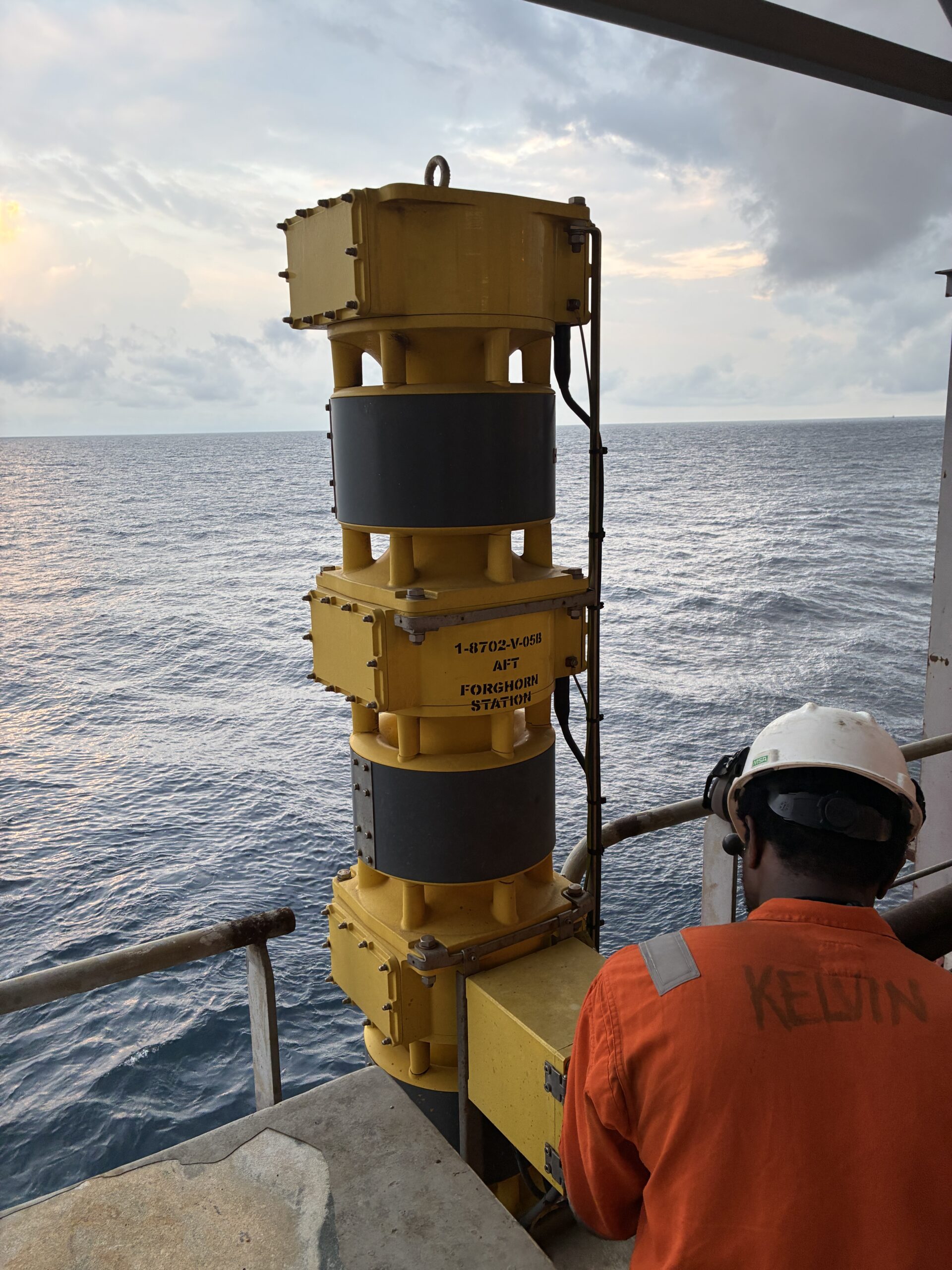
With over 23 years working hands-on with Aids to Navigation, our own Brad Scarrott has fielded the same worry more times than he can count: “we don’t think our fog signal is working.” More often than not, it is. In this piece, Brad shares what really affects fog signal performance offshore, and how to tell a genuine fault from a false alarm.
The humble Fog Signal, sometimes improperly termed a Fog Horn, has been used as a marine Aid to Navigation since the 18th century, when the warning signal came from the firing of a cannon at a location deemed optimal for passing ships.
Today, we still use Fog Signals as a way of marking an obstruction or hazard at sea, albeit to a diminishing extent, in favour of supplementary digital based AtoNs, but nevertheless, they still play an important part in the marking of man-made fixed offshore structures. For the intended audience of this article, we are generally discussing the use of Fog Signals for fixed platforms, jack-ups, semi-submersibles, stationary FPSO’s etc.
Over my 23 years’ experience working with AtoNs, I have been approached with the same statement on many occasions: ‘”We don’t think our fog signal is working’’.
My first response is normally “why do you think that?” The answer I usually get: “the support vessel cannot hear the signal at 2 nautical miles.” For those unfamiliar with offshore fog signals and their intended use, a signal should become operable, either manually or automatically when the visibility at that location falls too or below 2NM. Now, this is where things get interesting, and I’ll try my best not to sound like an irritating know-it-all.
The complicated science behind how fog signal sound waves are produced and propagate makes the perceived performance hard to illustrate or rationalise. A number of factors can contribute, either on their own or in combination, to an assumption of failure or sub-optimal performance. Here are a few of the common factors affecting the performance or observed performance of offshore fog signals:
- Hearing – it sounds obvious, but how do we know the person attempting to measure a 2NM morse code U signal by Ear, has a ‘”reasonable’’ level of hearing.
- Wind speed and direction – this can affect signal propagation and the perceived performance of the fog signal.
- Height differential – If there is a large height difference between the source and the position of the person wanting to test the range of the signal, then this can also have a considerable impact on the apparent performance.
- Obstructions – Structures or obstructions added near an existing fog signal stack can have a detrimental effect on its output. They can reflect the signal back towards the trumpet assembly, creating a noise-cancelling effect that reduces its efficiency.
- Humidity – Very dry air, along with a strong wind (mentioned above) can have a power absorbing effect on the fog signal and influence the observed signal at a certain range.
- Excessive background noise at a similar or same frequency.
You might be thinking that this sounds fine and very plausible, but how do we prove the performance to OPRED or Coastal Inspector from Trinity House or Northern Lighthouse Board?
The best way to prove the functional performance of a fog signal once it is installed offshore, is to have it tested by an experienced Navaids Engineer. A typical 2NM fog signal consists of 3 output elements that combine to produce a ‘”summated’’ signal. The individual elements (known as emitters), each draw around 25-30w when blasting its morse code U signal, (measure the long blast for best results) under healthy conditions.
So as planned maintenance item, you can quite easily check the functionality of a fog signal and be very confident that its performance meets its requirement. For those of you with a more scientific mind-when fog signals are built at the factory, they are tested under proper scientific conditions using an Anechoic chamber which is not only soundproof but is designed to prevent sound wave reflections from the wall re-entering the emitter horn assembly. Each emitter is tested with a known input and its output measured at a fixed distance with a calibrated, tracible instrument. It is essentially, a pass or fail test.
There is some discussion about the agreed output value, but 133 – 134db at 1 meter is accepted.
If you would like to discuss your fog signal performance, or any AtoNs subject in general, please contact brad.scarrott@wellheads.co.uk for an informed chat.